
- Home
- Who We Are
- What We Do
- Industry Applications
- Circular Economy
- Media
- Information Packs
- Interesting Reads
- Component Preparation for Mission-Critical Applications
- What is Robotic Solder Dip (Retinning, Alloy Conversion, Alloy Refresh)?
- Reballing: What Is It And When Do You Need It?
- The Quiet Deadline: How Obsolescence Shapes Modern Production
- Is Your Supply Chain Safe? Combatting the Threat of Counterfeit Electronic Components
- Quality
- Contact
High-Reliability Electronics: The Hidden Risks Threatening Mission-Critical Systems and How to Ensure Reliability in a changing Supply Chain
Electronics in high-reliability sectors like aerospace, defence, avionics, and other mission-critical sectors are the backbone of safety, performance, and operational continuity. Yet these industries face a unique convergence of risks that most commercial electronics rarely encounter.
Long product lifecycles, extreme environments, and constrained supply chains create a perfect storm of reliability challenges. Understanding these risks, and how to mitigate them is essential for engineers, procurement teams and programme managers alike.
When Lifecycles Don't Align
A fundamental issue in high-reliability industries is the mismatch between component and system lifecycles. Semiconductor devices may only be manufactured for 2–5 years. Aerospace and defence systems often remain in service for 20–30+ years. This creates a critical dependency on components that are no longer available through authorised channels.
As a result: Procurement teams are forced into the grey market, risk of counterfeit or substandard components increases significantly, long-term sustainment becomes unpredictable.
Tin Whiskers: Microscopic but Catastrophic
Tin whiskers are microscopic conductive filaments that form on tin surfaces are a serious risk in modern electronics. These whiskers can grow to several millimetres in length, are capable of carrying electrical current, and can cause short circuits, arcing, and even complete system failure.
Tin whiskers have been linked to satellite malfunctions and military system faults, with growth accelerating under conditions such as thermal cycling, mechanical stress, and radiation exposure.
As a result, tin whiskers present a critical concern for aerospace, defence, and space applications.
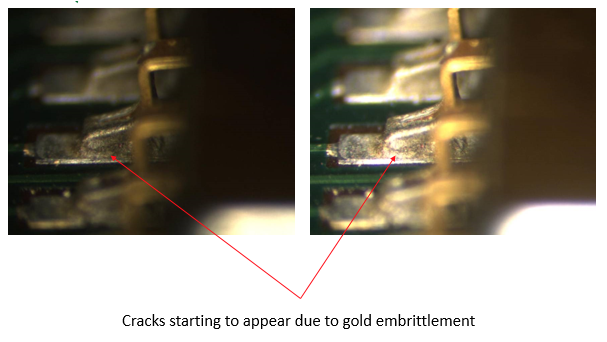
Gold Embrittlement & Failures
Gold plating is widely used for corrosion resistance and conductivity but when it’s not properly controlled, it can lead to gold embrittlement.
Engineering Reliability Back Into The Supply Chain
Retronix solves high-reliability electronics challenges through an engineering-led approach that prioritises control, traceability and long-term performance. Instead of relying on high-risk sourcing, components are recovered directly from known, authentic assemblies, eliminating counterfeit concerns and providing a dependable solution to obsolescence. Each device is then rigorously tested to recognised industry standards, ensuring it is fully functional and suitable for mission-critical applications.
Reliability is further strengthened through advanced processes such as alloy conversion, which replaces pure tin finishes to reduce tin whisker risk, and laser reballing, which restores BGA components without exposing them to damaging thermal stress. Retinning is also used where needed to restore solderability and extend component life. Delivered within an AS9100-controlled environment, this combined approach ensures components are not only available, but reliable, consistent and ready for use in the most demanding applications.
Contact us for more information

© 2024
UK: Retronix, North Caldeen Rd, Coatbridge, Scotland, United Kingdom. ML5 4EF / Email: sales@retronix.com / Phone: +44 (0) 1236 433 345
USA: Retronix Global Inc, 1007 S Heatherwilde Blvd, Ste.300, Pflugerville, TX, 78660 / Email: USA@retronix.com
USA: Retronix, 10560 Dr.M.L.K Jr Street North, St.Petersburg, FL, 33716 / Email:USA@retronix.com