
- Home
- Who We Are
- What We Do
- Industry Applications
- Circular Economy
- Media
- Information Packs
- Interesting Reads
- Component Preparation for Mission-Critical Applications
- What is Robotic Solder Dip (Retinning, Alloy Conversion, Alloy Refresh)?
- Reballing: What Is It And When Do You Need It?
- The Quiet Deadline: How Obsolescence Shapes Modern Production
- Is Your Supply Chain Safe? Combatting the Threat of Counterfeit Electronic Components
- Quality
- Contact
Retronix Featured in Jabil’s FY25 Sustainability Report: Circularity in Action
Sustainability only becomes meaningful when it is embedded into operations. Not bolted on. Not outsourced. Built in.
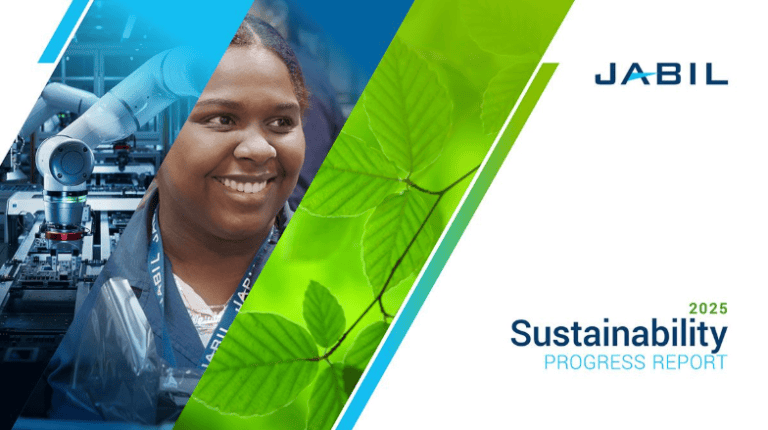
In its Fiscal Year 2025 Sustainability Progress Report, Jabil dedicates pages 50 and 51 to the impact of Retronix and its role in advancing circular supply chain solutions.
It’s a clear signal. Circularity is no longer a side initiative. It is becoming embedded into how electronics are managed at scale.
Circularity at Component Level
Electronics sustainability often defaults to recycling. Important, yes. But limited. The spotlight on Retronix focuses on one powerful idea: recovering value before it becomes waste.
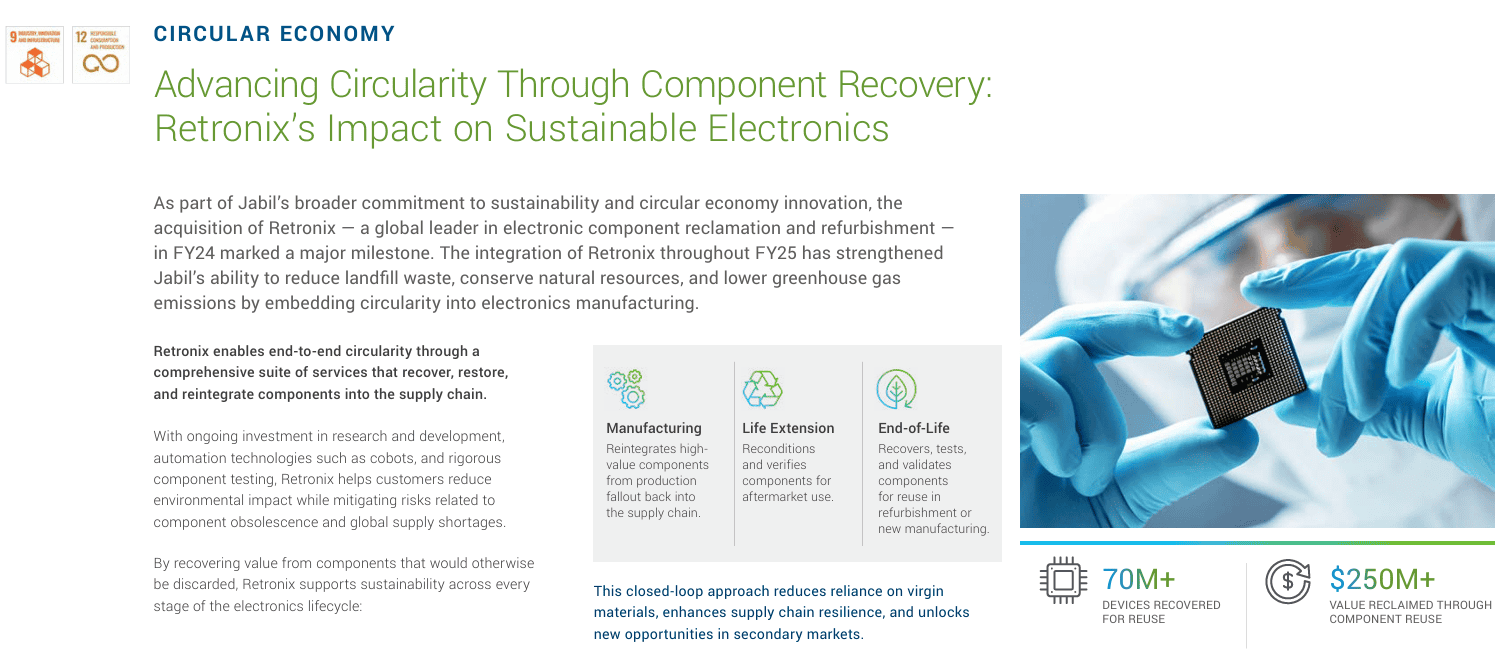
The section featuring Retronix focuses on something more powerful: component recovery and reuse. Instead of breaking products down into raw materials, viable semiconductor components are carefully removed from printed circuit boards, processed, tested and returned to usable condition.
That difference is significant.
Recycling breaks products down to raw materials. Component recovery preserves high-value devices in their functional form.
Circular Supply Chains in Practice
The report places Retronix within Jabil’s broader circular supply chain strategy. The emphasis is practical and measurable.
- Saving electronic waste from landfill
- Extending the lifecycle of semiconductor devices
- Increasing supply chain resilience
That final point carries weight. Semiconductor shortages over recent years exposed vulnerabilities across multiple industries. Component recovery creates an additional, sustainable supply stream, one that supports both environmental targets and operational continuity.
Sustainability and resilience are aligned.
Electronics is one of the fastest-growing waste streams worldwide. At the same time, devices are becoming more complex, more compact and more resource-intensive to manufacture. The pages highlighting Retronix show how high-reliability recovery processes can maintain quality while supporting sustainability goals.
Advanced services such as reballing, retinning, alloy conversion and testing ensure that recovered components meet strict standards before returning to production. This is not refurbishment in a casual sense.
It is precision engineering. Controlled processes. Documented validation. And it is scalable.
Embedding Sustainability into Operations
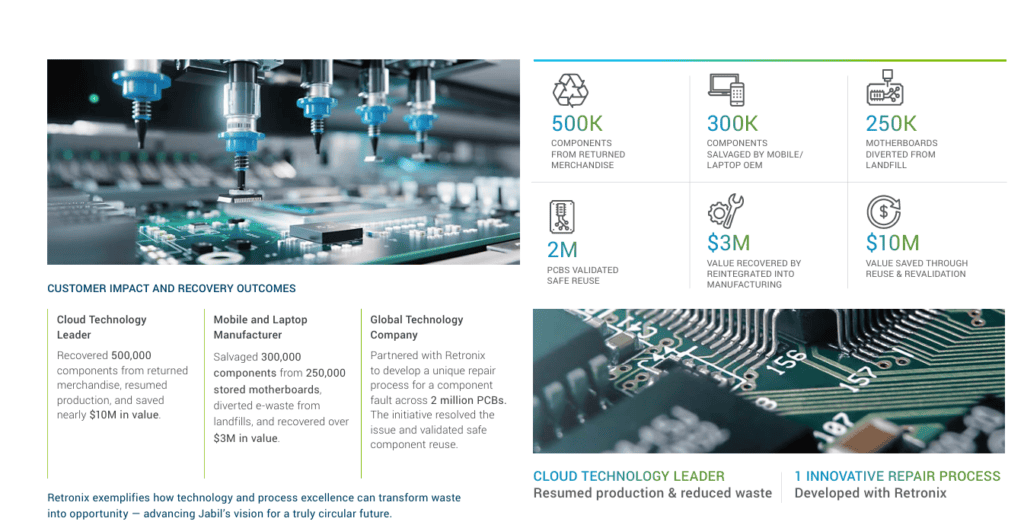
The broader FY25 report details progress in emissions reduction, landfill diversion and responsible operations across Jabil’s global footprint. Within that context, the inclusion of Retronix demonstrates how sustainability is being built directly into service capability.
Not as a marketing angle. As infrastructure.
By recovering and requalifying electronic components, value is retained within the system. Waste is reduced. Customers gain options that align environmental responsibility with operational continuity.
It’s a compelling model.
Perhaps the most important takeaway is this: sustainability in electronics is evolving.
The traditional linear model – manufacture, use, discard is being challenged. In its place, circular services are proving that technology need not be single-use. Complex components can have multiple lives when handled correctly.
That shift is both environmental and strategic.
As highlighted in the FY25 Sustainability Progress Report, it is already happening.
Reach out to us for a ready-made solution by using our contact page or by emailing us at contact@retronix.com

© 2024
UK: Retronix, North Caldeen Rd, Coatbridge, Scotland, United Kingdom. ML5 4EF / Email: sales@retronix.com / Phone: +44 (0) 1236 433 345
USA: Retronix Global Inc, 1007 S Heatherwilde Blvd, Ste.300, Pflugerville, TX, 78660 / Email: USA@retronix.com
USA: Retronix, 10560 Dr.M.L.K Jr Street North, St.Petersburg, FL, 33716 / Email:USA@retronix.com