High-Reliability Electronics: The Hidden Risks Threatening Mission-Critical Systems and How to Ensure Reliability in a changing Supply Chain

High-Reliability Electronics: The Hidden Risks Threatening Mission-Critical Systems and How to Ensure Reliability in a changing Supply Chain

Electronics in high-reliability sectors like aerospace, defence, avionics, and other mission-critical sectors are the backbone of safety, performance, and operational continuity. Yet these industries face a unique convergence of risks that most commercial electronics rarely encounter.

Long product lifecycles, extreme environments, and constrained supply chains create a perfect storm of reliability challenges. Understanding these risks, and how to mitigate them is essential for engineers, procurement teams and programme managers alike.

When Lifecycles Don't Align

A fundamental issue in high-reliability industries is the mismatch between component and system lifecycles. Semiconductor devices may only be manufactured for 2–5 years. Aerospace and defence systems often remain in service for 20–30+ years. This creates a critical dependency on components that are no longer available through authorised channels.

As a result: Procurement teams are forced into the grey market, risk of counterfeit or substandard components increases significantly, long-term sustainment becomes unpredictable.

Tin Whiskers: Microscopic but Catastrophic

Tin whiskers are microscopic conductive filaments that form on tin surfaces are a serious risk in modern electronics. These whiskers can grow to several millimetres in length, are capable of carrying electrical current, and can cause short circuits, arcing, and even complete system failure.

Tin whiskers have been linked to satellite malfunctions and military system faults, with growth accelerating under conditions such as thermal cycling, mechanical stress, and radiation exposure.

As a result, tin whiskers present a critical concern for aerospace, defence, and space applications.

Gold Embrittlement & Failures

Gold plating is widely used for corrosion resistance and conductivity but when it’s not properly controlled, it can lead to gold embrittlement.
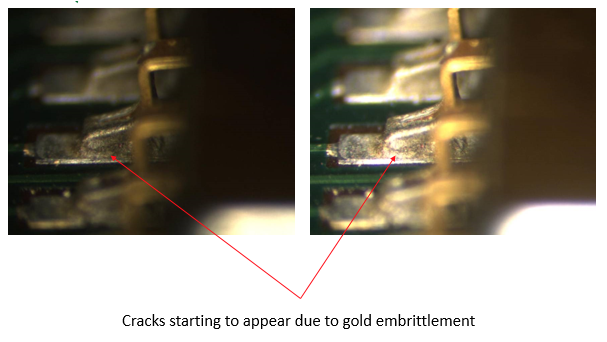
This issue arises when excess gold dissolves into solder joints, causing the joint to become brittle and susceptible to cracking. 
 
When combined with environmental and operational stresses such as vibration and thermal cycling, this brittleness can lead to premature mechanical failure.
Gold Embrittlement Issues - Cracked Solder Joints

Engineering Reliability Back Into The Supply Chain

Retronix solves high-reliability electronics challenges through an engineering-led approach that prioritises control, traceability and long-term performance. Instead of relying on high-risk sourcing, components are recovered directly from known, authentic assemblies, eliminating counterfeit concerns and providing a dependable solution to obsolescence. Each device is then rigorously tested to recognised industry standards, ensuring it is fully functional and suitable for mission-critical applications.

Reliability is further strengthened through advanced processes such as alloy conversion, which replaces pure tin finishes to reduce tin whisker risk, and laser reballing, which restores BGA components without exposing them to damaging thermal stress. Retinning is also used where needed to restore solderability and extend component life. Delivered within an AS9100-controlled environment, this combined approach ensures components are not only available, but reliable, consistent and ready for use in the most demanding applications.
Contact us for more information

From Shortage to Strategy: Managing DDR4, DDR5 and HBM Supply Challenges

From Shortage to Strategy: Managing DDR4, DDR5 and HBM Supply Challenges

It is no exaggeration in saying that the global memory chip market is experiencing significant disruption, with multiple DRAM categories under sustained pressure. What makes the current situation particularly challenging is that constraints are not isolated they are occurring simultaneously across both legacy and next-generation memory technologies.

From DDR4 shortages driven by supplier exits to DDR5 demand being pulled by AI infrastructure, the market is facing a perfect storm of reduced supply, shifting demand, and aggressive pricing increases.

For OEMs, EMS providers, and high-reliability sectors, this is a serious operational challenge.

Where are the bottlenecks?

DDR4 & LPDDR4: Structural Supply Reduction

DDR4 and LPDDR4 are currently among the most constrained memory categories. A major contributing factor is the exit of leading DRAM manufacturers from these nodes, significantly reducing global production capacity.

With fewer suppliers and limited new investment in these technologies, allocation has tightened, leaving many organisations struggling to secure consistent supply.

DDR5 & LPDDR5: AI is consuming capacity

While newer technologies like DDR5 and LPDDR5 are still in production, they are far from immune to disruption. Demand has surged due to the rapid expansion of AI-driven infrastructure, including:

  • High-performance computing platforms
  • Data centres supporting AI workloads
  • DDR5 RDIMM demand linked to server growth

This shift is absorbing a disproportionate share of manufacturing capacity, leaving other sectors competing for limited availability.

DDR3: Unexpected Pressure from Substitution

DDR3 is experiencing renewed pressure not just from legacy demand, but from substitution trends.

As LPDDR4 availability tightens, some consumer and industrial applications are shifting back to DDR3L as an alternative. At the same time, manufacturers are prioritising DDR4 output, further restricting DDR3 supply.

Legacy Memory: Stable, but Fragile

Older memory technologies such as SDRAM, DDR1, and DDR2 are currently stable in terms of supply and pricing.

However, this stability is deceptive. These categories rely on a shrinking pool of manufacturers, and any decision to discontinue or rationalise product lines could quickly disrupt availability.

The implications are clear

  • Longer lead times are becoming the norm
  • Allocation-based supply is limiting flexibility
  • Cost pressures are impacting project viability
  • Obsolescence risk is increasing for long-life programmes

For industries where product lifecycles extend well beyond standard semiconductor roadmaps such as aerospace, defence, industrial, and automotive. This creates a significant challenge.

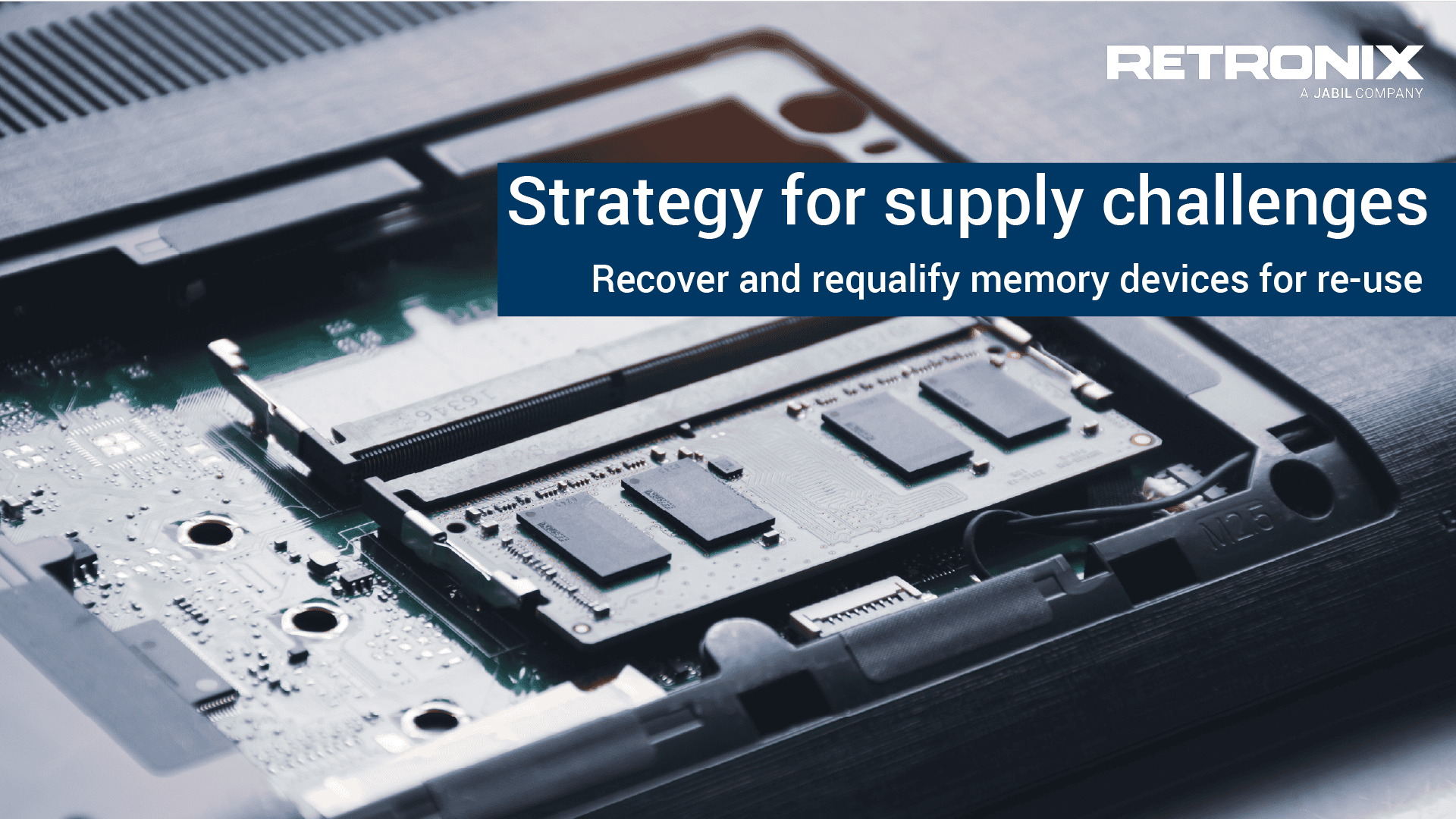
Solution: Recover, Reuse, and De-Risk Supply

Retronix provides a practical, immediate solution. By enabling component recovery and reuse from existing assets, Retronix helps organisations:

  • Unlock value from surplus or stranded inventory
  • Recover memory devices from PCBs for reuse
  • Maintain continuity without waiting for new supply
  • Reduce exposure to price volatility and allocation constraints

All recovered components undergo controlled, certified processes to ensure reliability and performance, making them suitable for use in high-reliability and mission-critical applications.

This approach not only addresses short-term shortages but also supports long-term obsolescence management and sustainability goals.

Don’t let market volatility dictate your future. Discover the hidden potential within your own operations. Retronix is uniquely positioned to help you turn scarcity into a strategic advantage, ensuring your production stays robust, resilient, and ready for anything.

Reach out to us today for a ready-made solution by using our contact page or by emailing us at contact@retronix.com.

The “Memory Device Squeeze”: Navigate the Wave of Semiconductor Shortages

Strained Supply Chains & Navigating Memory Device Shortages

If you thought the global chip crisis was a relic of the 2020 pandemic, the market data for 2026 tells a different and more complex story. While we aren’t seeing the “blanket” shutdowns of a few years ago, we have entered the time of supply chain disruptions, geo-political strains and product-specific shortages.

The industry is currently caught in a paradox: record-breaking revenues driven by the AI boom are coexisting with a bumpy supply chain that leaves traditional electronics manufacturers scrambling to keep production lines running. We’ve seen these cycles before. But this time, the solution isn’t just “waiting it out”, it’s about smarter recovery and reuse.

What's Actually Missing?

The current shortage isn’t every chip; it’s more a strategic reallocation of global manufacturing capacity.

The “AI Effect” on Memory (DRAM & HBM) The insatiable appetite for AI data centres has forced memory device manufacturing giants to pivot their production lines. They are focusing on high-margin High-Bandwidth Memory (HBM), leaving standard memory in the lurch. The price of DDR4 and DDR5 RAM has surged by up to 300% in some regions, hitting electronics production and server upgrades hard.

The Neglected “Mature Nodes” While the focus is on cutting-edge 3nm chips, the “standard” chips, the ones built on older 28nm to 90nm nodes are being neglected. As a result, Microcontrollers (MCUs) and Analog ICs are affected. These are the “nervous system” of cars, medical devices, and factory robots. Because investment is flowing into AI, the capacity for these essential parts is stagnant.

Power Management ICs (PMICs) As we move toward “Edge AI” (AI inside your phone or car rather than the cloud), the need for sophisticated power management has skyrocketed. The Victim: PMICs and Voltage Regulators. These components are critical for EVs and industrial automation. Without a £1 power management chip, a £50,000 electric vehicle cannot leave the factory.

Memory Device Shortages
Recover, reuse and test components with Retronix — extending product life, improving reliability and reducing obsolescence risk across your supply chain.

Your supply of Memory devices is closer than you think

The lead times for memory devices are stretching to over 40+ weeks, however your best inventory might already be closer than you think, sitting in your warehouse – it just needs a second life.

Retronix specialises in the circular loop in electronics.

Reclaiming Value from “Dead” Stock – Many companies have “failed” or “obsolete” PCBs that contain perfectly functional, high-value components. Our Component Recovery service uses precision, controlled processes to remove these chips safely. You get immediate access to components that are “out of stock” globally.

Making Old Components New: A component might be “unusable” simply because of oxidation on the legs or an outdated solder alloy. Retinning & Alloy Conversion: We can take components with old lead-free or tin-lead finishes and refresh them to meet current industry standards. BGA Reballing: We restore high-value BGA chips to “like-new” condition, allowing them to be soldered onto new boards with very high reliability.

Testing for Total Peace of Mind: Fully tested components for re-use. Retonix also provides Authentication & Counterfeit Detection: Ensuring that “stock” bought from unknown sources is actually what it claims to be. Electrical & Temperature Testing: Verifying that recovered parts perform exactly like a brand-new component from the fab.

Sustainability is the New Resilience

The shortage has proven that supply chain is fragile. By partnering with Retronix, you are navigating the complex environment with innovations that help create your own supply. You also end up reducing e-waste, recover lost value, dent the counterfeit market and protect your supply chains. It’s a clear winning strategy. 

Ready to bridge the gap?

Don’t let a missing MCU or a price-gouged DRAM kit halt your manufacturing.

Don’t let market volatility dictate your future. Discover the hidden potential within your own operations. Retronix is uniquely positioned to help you turn scarcity into a strategic advantage, ensuring your production stays robust, resilient, and ready for anything.

Reach out to us today for a ready-made solution by using our contact page or by emailing us at contact@retronix.com.